



The Loss of Curatorial Culture:
When Collections Become Invisible
Jing-Xuan Chen
Boston, 28 May 2026
During a recent visit to Harvard’s Museum of Comparative Zoology (MCZ), I spent time in the collection areas that are normally closed to the public. Unlike the exhibition galleries, these spaces were designed for storage and research: compact shelving, glass jars, metal tanks, historical and replacement labels, handwritten records, and specimens maintained by successive generations of curators. Some fish specimens had been preserved in ethanol since the nineteenth century. The rooms were quiet, functional and largely undecorated. Yet it was there, rather than in the public galleries, that the museum’s scientific identity became most visible.
What impressed me was not simply the scale of the collection. Large numbers can easily become a form of institutional rhetoric. What mattered was the evidence of continuous care. Bottle types were discussed not as trivial containers but as long-term preservation decisions. Label materials were remembered by their performance over decades. Obsolete sealing systems were not forgotten; they remained part of the institution’s technical memory. A collection, in such a setting, is not a warehouse of biological objects. It is a scientific infrastructure maintained through judgement, habit and accumulated experience.
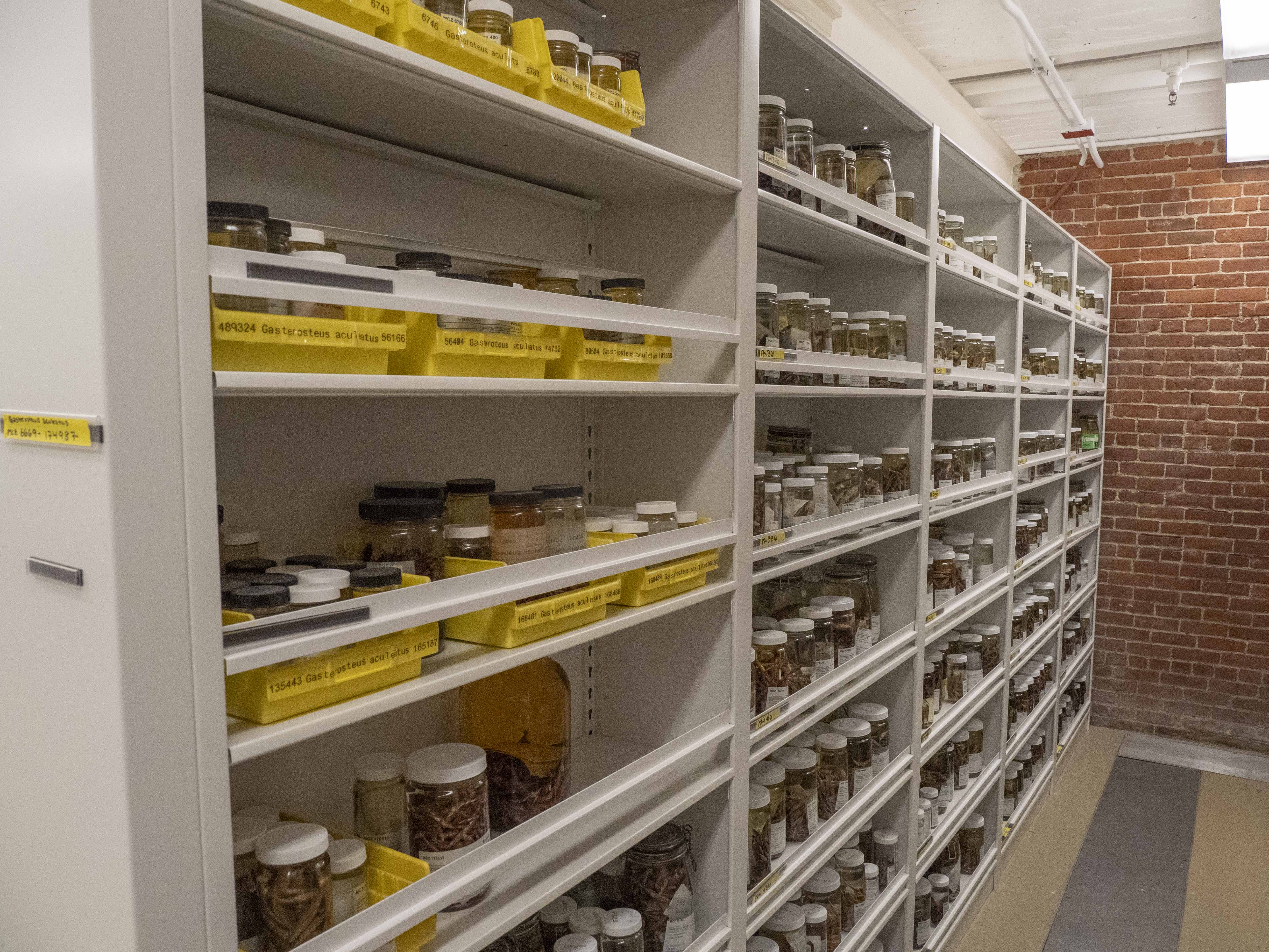
Fig.1 MCZ
For me, these observations were particularly striking because they contrasted with experiences I have had in China. Over the past several decades, many Chinese natural history museums have undergone rapid expansion and institutional transformation. New buildings have been constructed, exhibitions modernized and public engagement greatly strengthened. Yet in some institutions, collections have not received the same degree of attention. The result is not necessarily a lack of specimens, but a gradual weakening of the curatorial culture required to maintain them as long-term scientific resources.
This kind of curatorial culture is easy to overlook because it is rarely public-facing. Museums are now judged by metrics that favour visibility: visitor numbers, media reach, educational programmes, architectural presence and the novelty of exhibitions. These are not unimportant. Natural history museums must communicate with society, and good exhibitions can shape how generations understand biodiversity and evolution. But the growing dominance of visible success can obscure a quieter question: whether the institution still knows how to care for the material foundation on which its authority rests.
In many places, especially where museums have undergone rapid institutional restructuring over recent decades, natural history collections have been pushed into an ambiguous position. They remain useful in promotional language. They provide numbers for annual reports, legitimacy for institutional profiles and background authority for exhibitions. Yet they may no longer guide the museum’s priorities. The exhibition hall expands; the collection room remains understaffed. Public engagement becomes professionalized; preservation expertise becomes local, informal and vulnerable. The collection is still there, but it becomes intellectually peripheral.
This shift is particularly damaging for fluid-preserved collections. To the non-specialist, a fluid collection appears deceptively simple: an animal in a jar, liquid around it, a label inside or outside. In reality, fluid preservation is one of the most technically demanding forms of museum stewardship. Preservation fluids evaporate, containers fail, labels fade, seals degrade and chemical interactions unfold slowly. The consequences of a poor decision may not become visible for years. A collection can look orderly in a photograph while already carrying the signs of future damage.
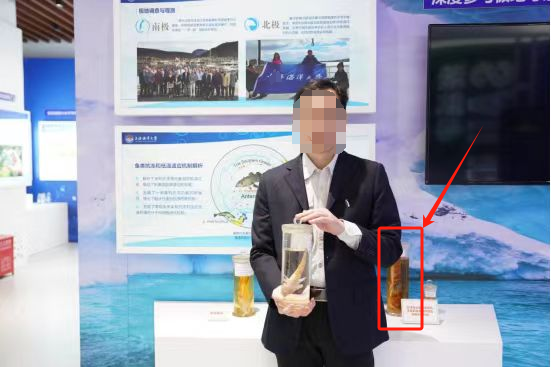
Fig.2 A specimen presented as evidence of collection strength during a museum publicity event. Ironically, the image also reveals a concern familiar to collection managers: the reddish discoloration visible in the background jar may indicate specimen deterioration. Such details are rarely noticed by audiences and, in some cases, may even escape attention during the production of promotional materials themselves.
This is why specimen counts alone are such a poor measure of collection value. A museum may claim hundreds of thousands or millions of specimens, but the number says little about whether they are usable. Are the labels stable? Are the fluids appropriate? Are the jars sealed? Are the specimens traceable to reliable data? Are type materials clearly marked and protected? Are old labels retained during transfers? Can researchers request material with confidence? These questions are less glamorous than exhibition design, but they determine whether a collection remains a scientific resource rather than a room of ageing objects.
A related problem is the uncritical attraction of novelty. Museums, like many public institutions, are often encouraged to adopt new materials, new systems and new technologies. The vocabulary of modernization is powerful. A new preservation chemical, a new display material or a new management solution may sound more advanced than a conventional practice that has survived decades of testing. Yet collections operate on a time scale that is unusual in contemporary administration. A procurement decision may be made within a year; a specimen may need to remain useful for a century.
In recent years, some materials originally developed for teaching or dissection specimens have been promoted for broader use in specimen preparation or storage. Products of this kind are often presented through the language of convenience, technical improvement or modern museum practice. The specific brand matters less than the institutional pattern: materials enter collections through channels in which novelty, appearance and administrative appeal can outweigh independent long-term evaluation. For exhibitions or short-term teaching, a material may seem acceptable. For permanent scientific collections, the burden of proof should be much higher.
Natural history museums are especially vulnerable to this confusion because they now occupy an uneasy space between scholarship and public entertainment. Many new museums are expected to be lively, interactive and visually impressive. They must compete with amusement parks, digital media and commercial cultural venues for attention. The result is not necessarily anti-scientific; many exhibitions are excellent. But a museum that is designed primarily as an experience can slowly lose the institutional temperament required for stewardship. Collections require patience, restraint and suspicion of easy solutions. They reward people who ask what will happen not next month, but in fifty years.
There is also a cultural difference between display and curation. Exhibition asks how an object can speak to the public now. Curation asks how an object can remain meaningful after the present institution, present staff and present questions have passed. These are not opposing missions, but they are not the same mission. When exhibition becomes the dominant language of a museum, collections risk being treated as backstage material: useful when they support a display, inconvenient when they demand space, expertise and money. The danger is not that museums become popular. The danger is that popularity becomes detached from the material basis that made them museums in the first place.
Well-curated collections show a different logic. Research, teaching and exhibition are not separate activities competing for attention; they all draw from the same preserved record of life. A specimen collected decades ago may support a taxonomic revision, illustrate a functional trait in a classroom, provide tissue for molecular work, document a vanished population or become part of a public exhibition. Its value is not fixed at the moment of collection. It accumulates through care, documentation and reuse. The more carefully a collection is maintained, the more futures it can support.
This is the point that many institutions fail to grasp. Collections are not burdens inherited from an older style of natural history. Nor are they statistics to be displayed when convenient. They are infrastructure: slow, expensive, fragile and irreplaceable. Buildings can be renovated. Exhibitions can be redesigned. Digital systems can be replaced. But once a specimen deteriorates beyond use, once its data are lost, once its labels are separated from its body, the loss cannot be repaired by future funding or better technology.
The most important room in a natural history museum may therefore be the room most visitors never enter. It may contain no theatrical lighting, no multimedia installation and no carefully scripted visitor path. It may smell faintly of ethanol, or, in the best-managed collections, almost not at all. It may look ordinary to a visitor and endlessly informative to a curator. In that room lies the difference between a museum that displays nature and a museum that preserves the evidence from which knowledge of nature can continue to grow.
A natural history museum can certainly be beautiful. It can be popular, educational and technologically inventive. But if its collections become invisible to its own institutional imagination, it risks becoming elegant at the surface and hollow at the core. The future of natural history museums will not be secured only by better exhibitions. It will depend on whether they can preserve, renew and respect the curatorial culture that makes exhibitions, teaching and research possible at all.