



On the Eleotris of China
Jing-Xuan Chen
April 4th, 2026
Eleotris, commonly referred to as gudgeons, is a notable genus that includes several species of economic importance, and remains one of my favorite gobies, owing to their cryptic predatory habits, relatively large body size, and typically amphidromous life history. Yet, despite their familiarity, the taxonomy of these fishes remains imperfectly understood. Distributed widely across tropical and subtropical regions, many species exhibit only subtle morphological differences, rendering their identification difficult and their nomenclature uncertain. It is therefore not always clear how nomenclatures established from different parts of the world correspond to one another.
Over the several years of goby exploration, a number of Eleotris specimens have been collected, many of which were at first of uncertain identity. With the accumulation of comparative material and the increasing availability of public sequence data, some of these forms may now be more confidently interpreted, while others continue to suggest unresolved diversity.
In the past two decades, the volume of sequencing data generated in China has grown significantly, with many researchers contributing to large-scale surveys through molecular methods. However, a challenge arises because many of the scientists involved in sequencing are not specialists in species identification or taxonomy. As a result, sequences are often mislabeled under incorrect species names, leading to potential errors in the species identification. Despite these challenges, there is still great potential to uncover hidden diversity within these datasets. By comparing Chinese-generated sequences with well-curated, revised databases, we can start to reveal patterns of diversity that might otherwise go unnoticed. However, the ability to thoroughly revise and accurately identify species from sequencing data remains a rare skill within the Chinese scientific community.
It is believed that China is home to four species of Eleotris, along with numerous synonyms, both junior and senior, that have historically been attributed to one of these four species. The table below includes these species and their associated synonyms, all of which have been recorded as occurring in Chinese waters at various times.
|
Possible valid Eleotris names reported in China |
||||
|
Original described name |
Current treatment |
Year of description |
Type locality |
Reference |
|
Eleotris acanthopomus |
Valid as Eleotris acanthopomus |
1853 |
Western Sumatra |
Bleeker [P.] 1853:275 [Natuurkundig Tijdschrift voor Nederlandsch Indië v. 4 (no. 2)] |
|
Eleotris acanthopoma hainanensis |
Synonym of Eleotris acanthopomus |
1991 |
Wanquan River, Hainan Island |
Wu [H.-L.] 1991:432 [English p. 434], Fig. 258 [Freshwater fishes of Guangdong Province, China] |
|
Eleotris wanquanicus |
Synonym of Eleotris acanthopomus |
2012 |
Same as Eleotris acanthopoma hainanensis |
Prokofiev [A. M.] 2012:164, Fig. 258 [Aktualnye Problemy Sovremennoy Nauki v. 5] |
|
Eleotris wuhanlini |
Synonym of Eleotris acanthopomus |
2024 |
Same as Eleotris acanthopoma hainanensis |
Endruweit [M.] 2024:74, Fig. 180 [Fishes of the Red River - Perciformes, Synbranchiformes] |
|
Poecilia fusca |
Valid as Eleotris fusca |
1801 |
Raiatea |
Bloch [M. E.] & Schneider [J. G.] (ex Forster) 1801:453 [M. E. Blochii, Systema Ichthyologiae] |
|
Eleotris melanosoma |
Valid as Eleotris melanosoma |
1853 |
Wahai, western Sumatra |
Bleeker [P.] 1853:705 [Natuurkundig Tijdschrift voor Nederlandsch Indië v. 4 (no. 2)] |
|
Eleotris hainanensis |
Synonym of Eleotris melanosoma |
1933 |
Haikou, Hainan Island |
Chen [J. T. F.] 1933:370, Figs. 1-2 [Bulletin du Musum National d'Histoire Naturelle (Srie 2) v. 5 (no. 5)] |
|
Eleotris fortis |
Synonym of Eleotris melanosoma |
1912 |
Tamsui River, Taipei, Taiwan Island |
Tanaka [S.] 1912:106, Pl. 27 (figs. 108-109), 28 (fig. 113) [Figures and descriptions of the fishes of Japan v. 6] |
|
Eleotris fasciatus |
Synonym of Eleotris melanosoma |
1964 |
Lanyu |
Chen [T.-R.] 1964:45, Fig. 4 [Quarterly Journal of the Taiwan Museum (Taipei) v. 17 (nos 1-2)] |
|
Eleotris oxycephala |
Valid as Eleotris oxycephala |
1845 |
Japan |
Temminck [C. J.] & Schlegel [H.] 1845:150, Pl. 77 (figs. 4-5) [Fauna Japonica Parts 7-9] |
|
Eleotris cantherius |
Synonym of Eleotris oxycephala |
1846 |
Macao |
Richardson [J.] 1846:209 [Report of the British Association for the Advancement of Science 15th meeting [1845]] |
|
Eleotris balia |
Synonym of Eleotris oxycephala |
1905 |
Hong Kong |
Jordan [D. S.] & Seale [A.] 1905:526, Fig. 6 [Proceedings of the United States National Museum v. 29 (no. 1433)] |
I once thought that a common and "well-defined" genus like Eleotris would have a very stable classification. However, things started to get interesting when I noticed that Eleotris melanosoma from the Pearl River delta and Hainan Island showed distinct morphological differences from those found on Taiwan Island, prompting me to reconsider the classification of Eleotris in the Chinese region. Additionally, in the past decade, significant efforts have been made to study Eleotris from the Sunda Islands and the Indian Ocean by colleagues abroad, which inspired me to apply molecular methods to help clarify the identification of Chinese Eleotris.
I collected all available Eleotris COI sequences from NCBI and BOLD, assigning geological tags where possible. This effort yielded a total of 972 Eleotris sequences. For the analysis, I used two Bunaka sequences as outgroups, aligned the sequences using MAFFT v7.407 with the –auto setting, and then employed IQ-TREE v2.0.7 with the following settings: -m GTR+F -nt 30 -st DNA -bb 1000 --seed 100000 to calculate a phylogenetic tree. Based on locality, sequence names, and references from multiple journals, I examined how the sequences from China clustered with other species, resulting in an atlas that expands our understanding of Eleotris in Chinese waters.
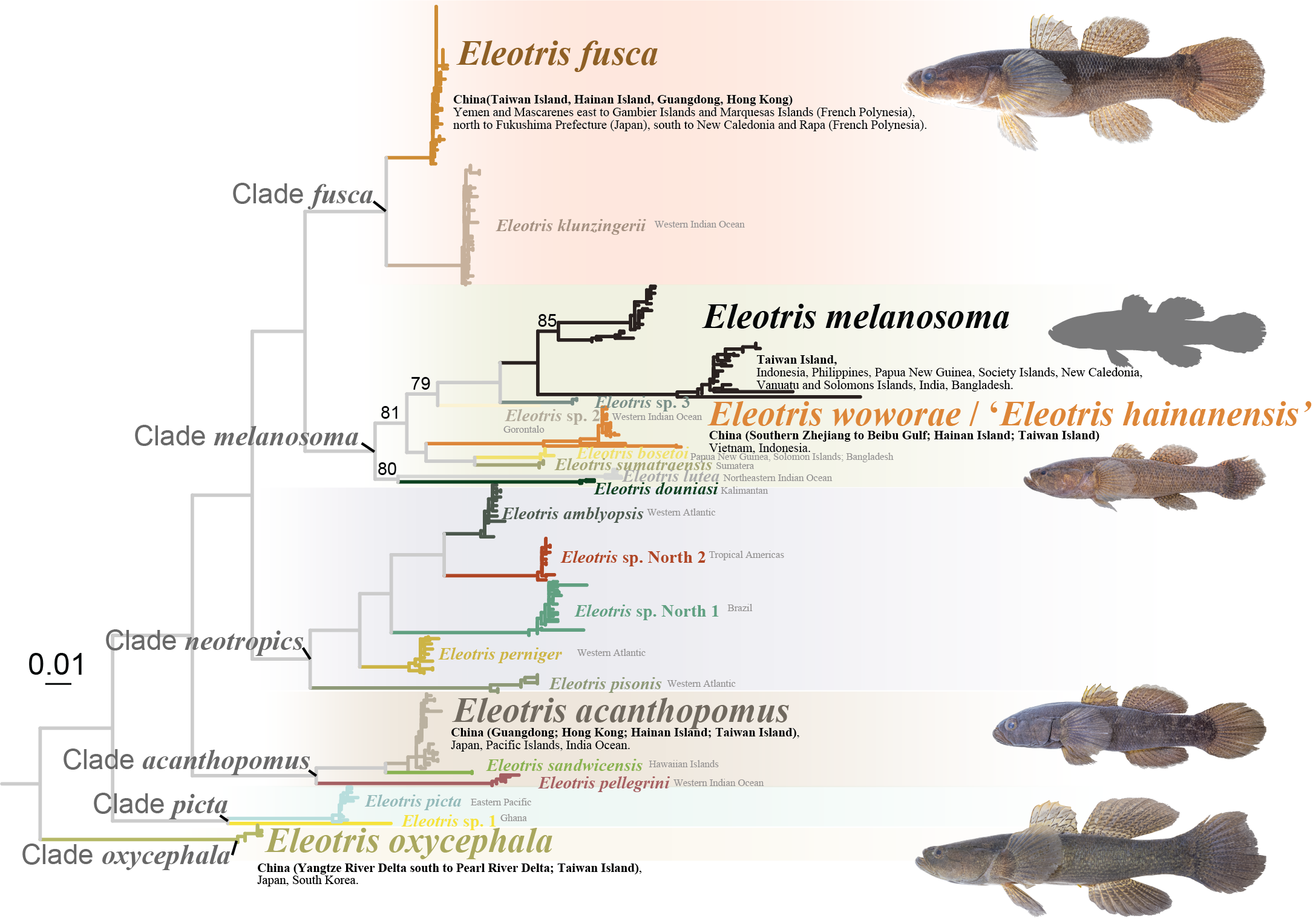
Fig. 1. Phylogeny of all COI sequences in the genus Eleotris from public databases. Species names in larger font indicate those occurring in China. Bootstrap values greater than 95 are not shown in the plot. The tree is rooted on outgroups, which are removed for display. Eleotris fusca has been pruned off due to an excessive number of sequences, which would unbalance the tree. The full PDF version can be downloaded here.
From the tree, we can observe that the public Eleotris COI sequences can be roughly divided into seven major clades. Apologies if I have missed any existing studies, but I have not found any research articles that explicitly name these clades, so I have personally assigned them names. Starting from the earliest-diverging clades, the first is Clade oxycephala, which includes a long branch leading to Eleotris oxycephala from China and Japan. This clade clusters into a single group with minimal divergence within it. Next is Clade picta, which consists of two lineages: one representing Eleotris picta from the Eastern Pacific and the other an unidentified sequence from Ghana. This clade does not occur in China.
The third clade, Clade acanthopomus, occurs in China once again. There are three COI sequence lineages within this clade: Eleotris acanthopomus, which is found in Taiwan, Hainan, coastal Southern China, as well as Japan, the Pacific Islands, and the Indian Ocean. Hanlin Wu, a gobioid researcher in China, once proposed a potential subspecies of Eleotris acanthopomus on Hainan Island, naming it Eleotris acanthopomus hainanensis. However, this subspecies designation was later removed by Wu in his Fauna Sinica book. This treatment did not gain international recognition, and subsequent researchers elevated this subspecies to species level. However, since Eleotris hainanensis was already preoccupied, they renamed it Eleotris wanquanicus and Eleotris wuhanlini as nomenclature replacements. Yet, based on the tree, it is clear that at least from the COI sequence, the Chinese Eleotris acanthopomus does not show any distinctive features. Therefore, these names may not be valid. Since this blog is not a revised article, it would require someone—possibly myself, if I have time—to formalize this treatment. Additionally, two lineages in this clade, which do not occur in China, represent distinct species.
The fourth clade of Eleotris is named Clade Neotropics, as the majority of its lineages are found along the tropical coasts of the Americas, particularly in the Atlantic. There is a wealth of literature on this clade, but it is not the focus here. The fifth clade, which I call Clade melanosoma, is the most intriguing. Thanks to extensive research on this group, most of the lineages can be assigned a name. The Indo-Pacific clade contains about eight COI lineages, two of which have been found in Chinese waters. The first is the ‘true’ Eleotris melanosoma. However, even within this lineage, there are multiple sub-lineages based on COI sequences. Here, I follow Mennesson et al. (2021), who treat these as one species. Four sequences of this lineage have been reported to be obtained from Taiwan Island.
But where is the Eleotris melanosoma from coastal China? I discovered that some sequences reported under the name of Eleotris fusca in this clade appear in a different lineage. These sequences are from Guangdong, Beibu Gulf, Taiwan Island, and Vietnam. What surprised me, however, was a sequence from Bali, Indonesia. Upon closer examination, I found that it corresponded to the holotype of Eleotris woworae, a species described in 2021! The photo of Eleotris woworae from Indonesia closely resembles the southern Chinese ‘E.melanosoma’, with many of the same morphological traits, and they share identical COI sequences. Thus, at least the southern Chinese ‘E.melanosoma’ may be assigned to this species. But is that enough? In China, at least three different names are used: Eleotris hainanensis (which is also why some have replaced the earlier Eleotris acanthopomus hainanensis), Eleotris fortis from Tamsui River, Taipei, Taiwan Island, and Eleotris fasciatus from Lanyu. Upon reviewing the original descriptions, I found that the specimen referred to as Eleotris hainanensis may actually correspond to the one found in southern China, while the other two names likely refer to synonyms of the true E.melanosoma, at least from a COI perspective. Under this scenario, Eleotris woworae may still not be the final name for the species, and E.hainanensis could potentially be the correct one, though further research is needed to confirm this. This discovery has been quite surprising, and it underscores that more work is needed to confirm these findings—whether done by others or, if time permits, by myself.
The final clade, however, is relatively simple. Clade Fusca is formed solely by two species: Eleotris fusca and Eleotris klunzingerii. The latter is found in the Indian Ocean, while the former can be found in China. Although most records are from Taiwan Island, I have come across specimens and photographic reports from Guangdong and Hong Kong, as well as some of my personal collections of the species from Hainan Island.
I currently have specimens of four out of the five Eleotris species from China, with the final species, E.melanosoma, which has mainly been reported from Taiwan Island, still elusive. Despite the progress made in collecting and identifying these species, there is still much more to learn. The reason I am writing this blog and sharing my findings is that I believe a comprehensive review of the genus requires not only the expertise of local researchers but also an international collaboration that brings together diverse perspectives and resources. The complexity of species identification, especially in a genus with widespread distribution and subtle morphological differences, calls for a concerted effort to expand sampling and improve data quality across the region.
To truly unlock the full diversity within the Eleotris genus, we must go beyond simply identifying species from a few locations. A broader, more comprehensive sampling effort is essential, covering various ecological regions and ensuring that all potential species are captured. Furthermore, a more meticulous morphological examination, supported by molecular data, is critical to resolve the ongoing taxonomic ambiguities. It is clear that the Eleotris species in China, as well as those across the Indo-Pacific region, may hold hidden diversity that is yet to be fully understood. Therefore, I call for more coordinated research efforts, and for scientists to approach this challenge with both patience and a willingness to collaborate internationally. Only through such efforts can we hope to unravel the full complexity of this fascinating genus.